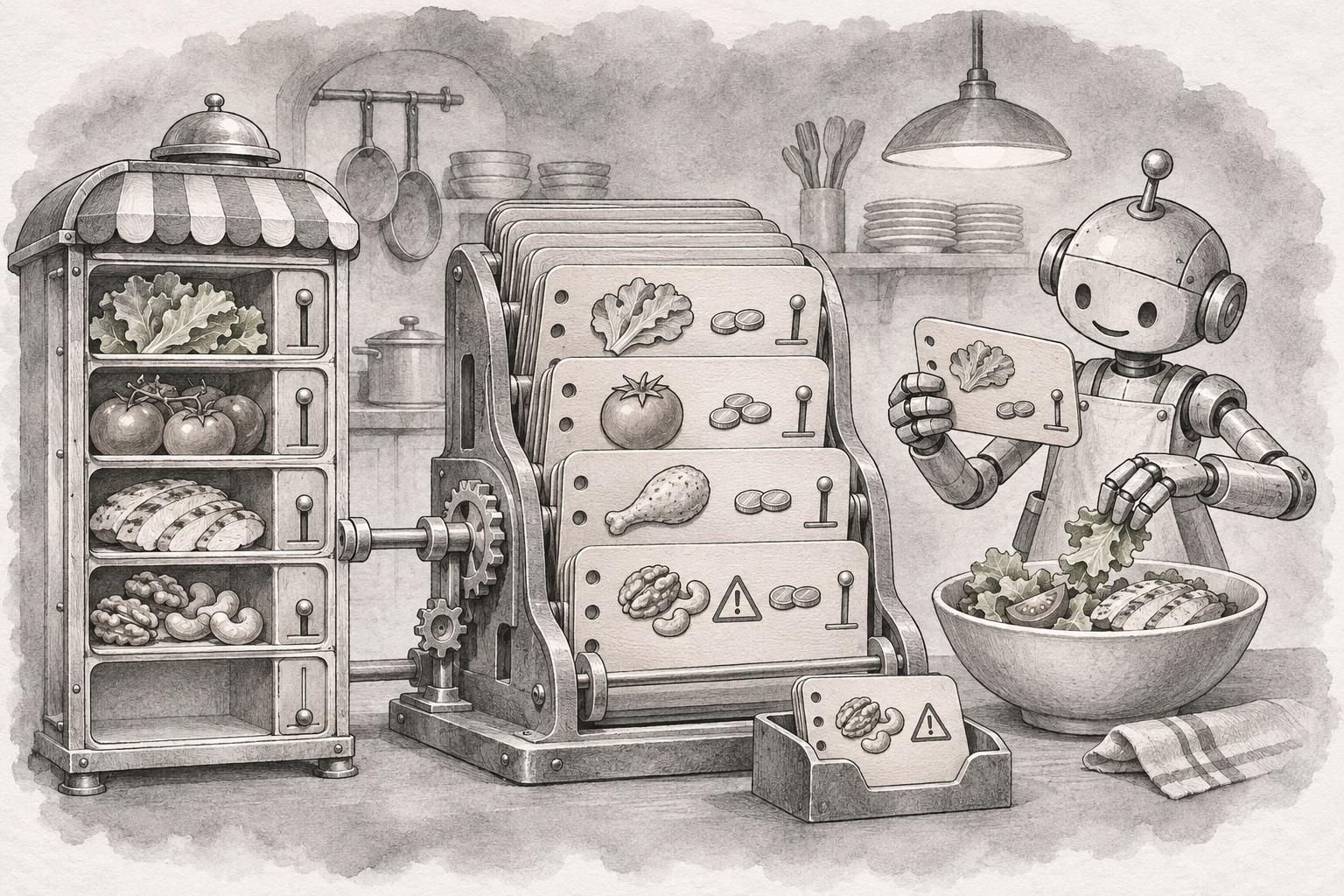
Every ingredient, allergen and price on Sweetgreen's menu is published as data, accurate to the individual restaurant. That was the precondition for what the chain announced on 18 November: a diner can state a protein target or an allergy inside Claude or ChatGPT and have an order composed in the conversation.
Wouleta Ayele, Sweetgreen's chief technology officer, put the dependency in a single line in the Business Wire release: "That only works if the agent has ingredient information it can trust." Ayele also named the behaviour the company is building for: "We're seeing a real shift from searching to delegating," in comments Lisa Jennings reported at Nation's Restaurant News the same day.
The connector was the smaller half of the work
On the assistant side the mechanics are thin. A customer finds Sweetgreen in the Claude or ChatGPT app directory, enables it once, asks for something, confirms which of the 289 locations they mean, browses a visual menu carrying prices, calories and allergens, and adds items to a bag. The sample prompts on Sweetgreen's own ordering page are the kind of request that only resolves against dish-level data: "Build me a filling lunch that's under 500 calories."
Underneath that sits the part no directory listing provides. Sweetgreen describes the menu record it exposed as covering ingredients, nutrition, allergens, pricing and real-time availability at each restaurant, and says it tuned that data against how the assistants actually respond to customer requests. The integration took a release cycle. The dataset took a decision about what the company was willing to state about each dish.
Real-time availability is what a published file struggles with
Per-restaurant availability is the demanding field. Ingredients and allergens hold for a season; what is actually behind the counter at one site at 1pm does not. Markup written once and left alone describes a menu rather than a kitchen — a dish comes off at one location, and the JSON-LD on the page carries on offering it.
That gap is survivable for a diner who can read the page and shrug. It is not survivable for software composing an order against a stated allergen, which is why Sweetgreen's record is generated from the same system that knows a site has run out.
The chain will not vouch for the sentence the assistant produces
The disclaimer on Sweetgreen's ordering page is unusually direct. Chat responses may contain errors or outdated information. Current details on products, pricing, ingredients, allergens and nutrition live on the website and the app. Anyone with a food allergy is told not to rely on a chat response to judge whether an item is safe. Dietary preferences entered online are not passed to the teams in the shops.
Read that alongside the launch and the division of labour is clear. The structured record is the thing Sweetgreen stands behind; the generated paragraph quoting it is not. Which puts the whole weight of the feature on the record being right.
Payment stayed on Sweetgreen's own property
The assistant does discovery and composition, then stops. Checkout happens in the Sweetgreen app or at order.sweetgreen.com, where the rewards, credits and saved cards are. Jennings sets the launch beside Gett Technologies' First Party Everywhere, a direct-to-merchant network announced this month to push agent-driven demand into restaurants' own ordering platforms rather than a marketplace's. Both are bets that the assistant becomes the shop window and not the till.
The requirement scales down even though the engineering does not
A chain with 289 sites, a chief technology officer and a connector in two app directories is not a template for a single kitchen. What transfers is the dataset rather than the plumbing: dish names, sections, prices, ingredients, allergens, dietary flags and what is off today, published somewhere anything reading the web can take it. That is a publishing job rather than an integration project, and the tools in that category — GMMO among them — emit the markup as a by-product of someone changing a price.
Roughly six in ten millennial and Gen Z adults told the National Restaurant Association they would place an order with an AI bot. The assistants arriving to serve them each bring their own directory and their own connector format, and the facts they ask for on the way in do not vary between them. A bespoke build answers one assistant. A published menu record answers whichever one the diner happens to open.