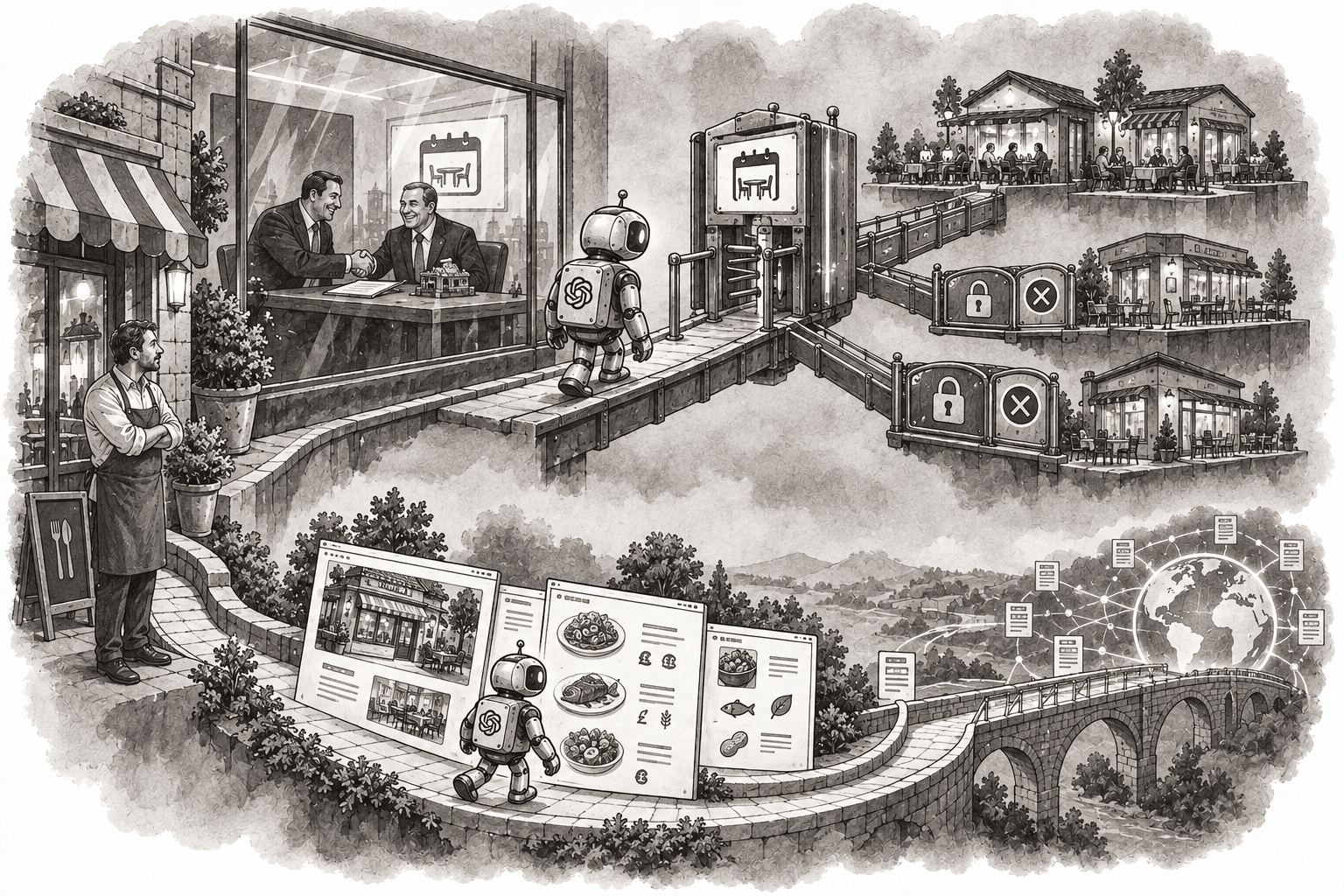
Amazon cut Meta's Muse agent off from its retail site on Sunday night. Anyone who asked Muse to browse or buy on Amazon began seeing a pop-up: continued access by "an unauthorized AI agent violates Amazon's Conditions of Use, to which our customers have agreed." Muse had reached the top of the US App Store's free chart in the days before, displacing ChatGPT. It also books restaurant tables.
Muse reaches restaurants through exactly one platform
Meta launched Muse on 8 September, to US adults only, on a free tier with $20 and $100 monthly plans above it. The integrations named at launch were Google Workspace, Ticketmaster, OpenTable, Spotify and Apple Health. Restaurant reservations run through OpenTable. There is no second path.
A restaurant that takes bookings somewhere else, or through a form on its own site, is not reachable by the agent currently sitting at the top of that chart. Muse did not assess it and decline; Meta signed one restaurant integration, and that integration belongs to OpenTable.
Amazon's objection is that the agent did not say who it was
Amazon's public position is not that agents are unwelcome. Its statement puts the condition plainly: "Third-party applications that offer to make purchases on behalf of customers from other businesses should operate openly and respect service provider decisions." It adds that "agentic third-party applications such as Muse have the same obligations, and we've requested that Meta remove Amazon from the experience."
Amazon runs a shopping agent of its own, Buy for Me, which identifies itself and lets brands opt out. Muse, by Amazon's account, did neither, and the block followed an unsuccessful request that Meta simply drop Amazon from the Muse experience.
There is a pattern behind it. Over the past year Amazon has sued Perplexity over its Comet browser and blocked the shopping agents built by Google and OpenAI.
Restaurants sit on the other side of the same asymmetry
Amazon has a login wall, a checkout, a conditions-of-use document and the legal department to enforce it. It can decide which agents act on its pages and on what terms. A restaurant's menu page has none of that machinery. It is a public document, open to whatever wants to read it.
That reverses which risk matters. Amazon's exposure is an agent it did not admit. A restaurant's exposure is the opposite: an agent that never arrives at the site at all, because a reservation platform has already answered on its behalf, using the fields that platform happens to hold and none of the ones it doesn't.
Access is turning into a commercial term
Liat Ben-Zur, a former Microsoft vice-president, is quoted in Fortune's account saying that "companies that control the rules of access will have enormous influence over whether those agents actually work for the consumer." That influence is being exercised between large companies at speed. Meta negotiated with OpenTable. Amazon negotiated with nobody and shut the door. The restaurant whose table is being booked was not in either conversation, and will not be in the next one.
Nikesh Arora, chief executive of Palo Alto Networks, expects more of these agents: "It is only a matter of time before there is an Apple and Google version of Muse and possibly TikTok." Each will launch with its own integration list, and early lists are short.
The one account of a restaurant that nobody licenses
A restaurant's own domain is the description of itself that no access agreement governs. Dish names, sections, prices, allergen information and dietary flags, published as structured data on the restaurant's own pages, are readable by any agent allowed to fetch a web page, which for a public menu is all of them.
That will not put a restaurant into Muse's booking flow this month. OpenTable is the only thing that does. What it changes is what happens when an agent has a question the reservation record cannot answer, and whether there is anything on the open web to answer it. A menu left as a PDF or a photograph puts that answer entirely in the hands of companies the restaurant never signed anything with.