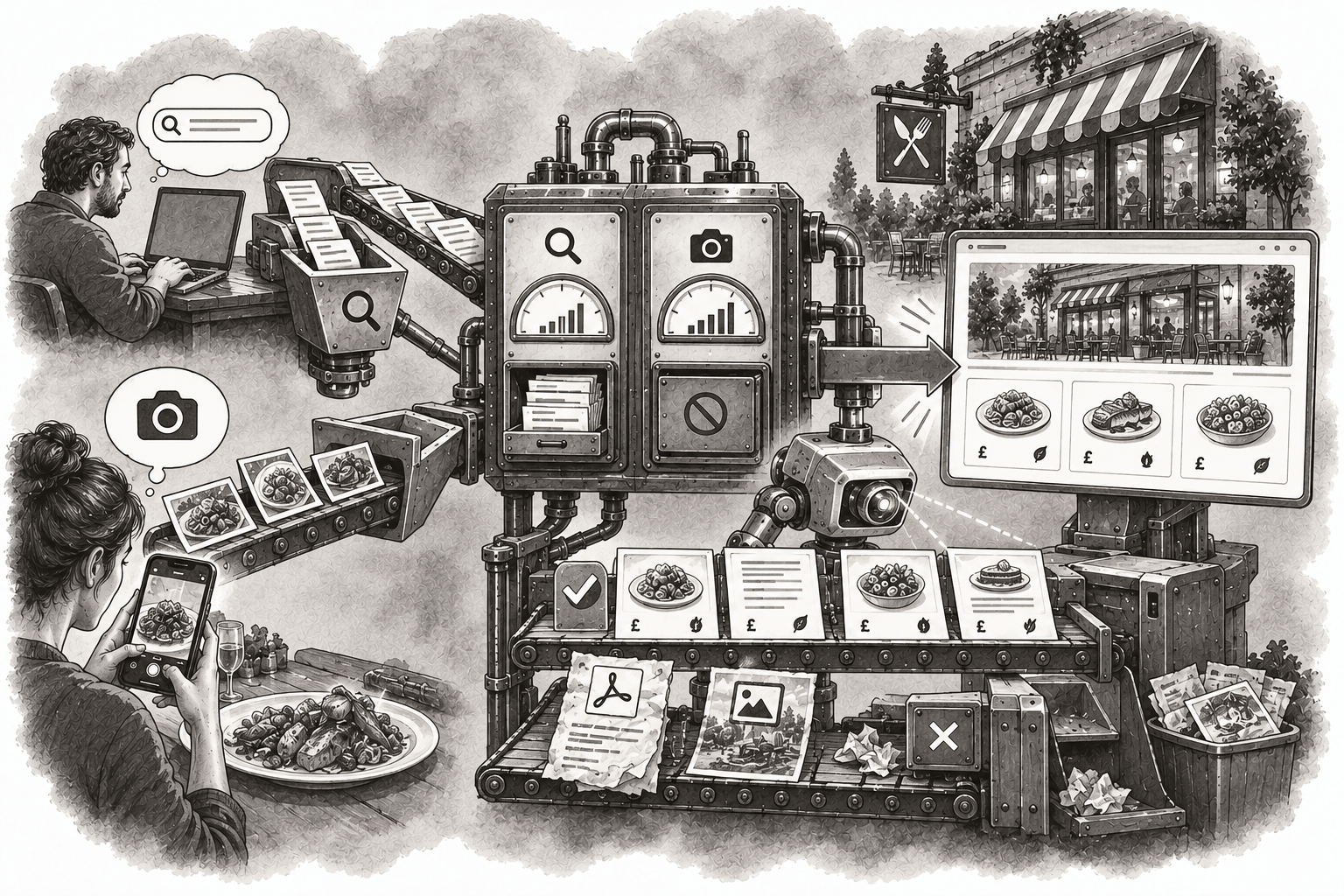
Search Console no longer lumps a typed query in with a photographed one. Under the Search type filter, web results split in two: "Text-based" and "Multimodal". Google announced the change on 24 September in a post by Harsh Kharbanda, who leads product on Google Lens, and Moshe Samet, who leads product on Search Console, and described the data as "rolling out globally starting today".
Multimodal means a web page found through a picture
The new bucket is not Google Images under another name. Search Console has carried an Image search type for years, and that one reports on a site's pictures turning up in image search. Multimodal reports on the ordinary web page — the menu, the opening hours, the contact details — surfacing because the query itself was a photograph. The help documentation puts it in a line: "Includes web search results where an image was used as part of the search."
What counts as an image query is a list, and it is longer than Lens. The announcement names "searches with Lens, Circle to Search on Android, image uploads to Google Search, and the Chrome right-click 'Search this image' feature". Lens is the camera. The other three start from an image the searcher already has on screen or on disk.
The queries dimension goes dark
This is the part that changes the job. Google's documentation is explicit about what the new filter withholds: "Because multimodal searches mostly use images rather than text, specific text query data isn't available for this traffic. As a result, the queries dimension isn't available when this search type is selected."
A restaurant can see that a page was served against an image query, and how often, and will never see what was in the picture. The usual loop — read the query report, notice the phrasing people actually use, adjust the page to match — closes here. There is no phrasing to read.
What is left is the page. If nothing but the page's own account of itself determines whether it satisfies a photographed query, that account has to hold up with no keyword anchoring it. A dish named, priced and tagged in JSON-LD is legible to a system working from a picture of a plate. The same dish set in a PDF, or rendered as type inside a JPEG of the printed menu, is not.
The same split landed in the AI report
Kharbanda and Samet put the multimodal data in two places: the performance report for Search results, and the report for Generative AI features. The second is the one restaurants have been watching since June, when AI Overviews and AI Mode impressions first acquired numbers. It distinguishes an AI answer triggered by typing from one triggered by a picture.
Barry Schwartz, reporting the rollout at Search Engine Roundtable the same morning, made a claim that is testable against your own account: "this is brand new data, this data was not even lumped into the web results (text-based results) report." If that holds, web totals should step up rather than redistribute, and a site that appeared to be flat since the spring may turn out to have been undercounted. He also marked the gap that survives the update. The generative AI report still carries no click data, and the multimodal half of it now carries no query data either.
Image-led discovery was already happening unmeasured
None of this creates a behaviour. People have been pointing phones at menu boards, shopfronts and plates for years; Google has simply started reporting it against the pages that answered. The number arriving in Search Console this week is a description of traffic that was already there, filed until now under a heading that gave no hint of where it came from.
For a chain with location pages, the useful first pass is comparative rather than absolute. Set the multimodal filter against the text-based one, site-wide, then per location. A branch whose image-led share runs well above the others is being photographed more, whether because of the street it sits on or the food people put on their phones. A branch at nearly zero is either in a quieter spot or is failing to be identified from a picture at all, and those two explanations call for different work.
An image query is a question that arrives with no words in it. Google has begun counting those questions and said in the same breath that it will not disclose what they were. That leaves the page answering on its own terms, in whatever form someone last published it.