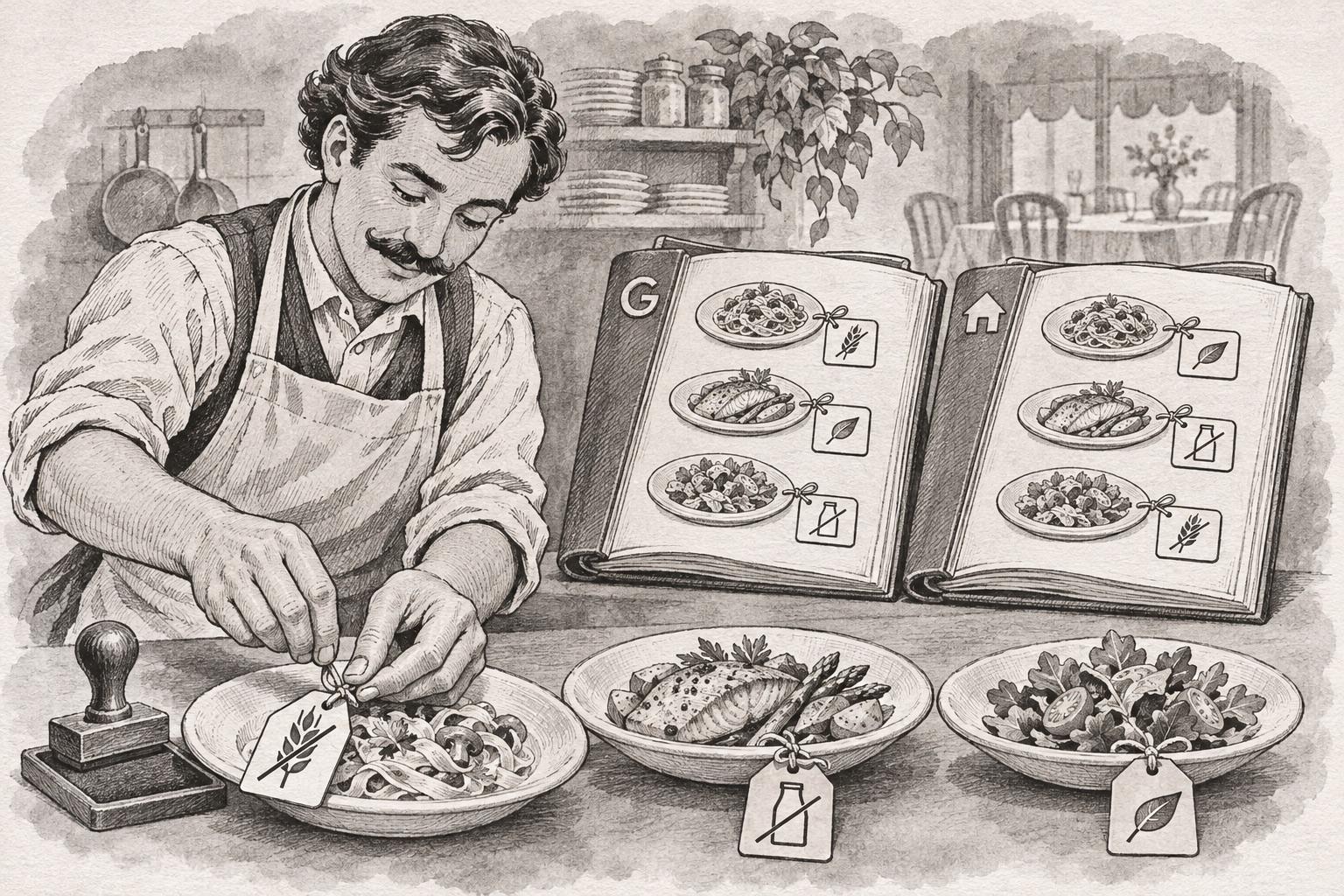
Google Business Profiles now carry four more dietary tags: gluten-free, dairy-free, halal and kosher. They attach to individual menu items rather than to the restaurant as a whole, and they join the vegetarian and vegan tags that were already there. Lisa Landsman at Google posted the change on LinkedIn, calling it "Great news for local restaurants"; Barry Schwartz wrote it up at Search Engine Roundtable on 13 October.
Landsman framed it around the work a diner currently has to do. "For millions of diners with specific dietary needs, dining out requires careful planning." Schwartz reports that the tags surface when someone searches Google Maps or Google Search for a specific diet, with "gluten-free dinner near me" as the example query.
The tag belongs to the dish
The route for an operator is short: open the Business Profile, select "Edit menu", choose an item, tick the badges that apply. That is a per-item decision, repeated item by item.
The granularity is the substance of the change. Until now a dietary claim in the profile described the business; now it describes the plate, and it does so in the place a diet-filtered query reads.
Schema.org already had most of this vocabulary
The Schema.org property suitableForDiet applies to MenuItem, and it takes values from the RestrictedDiet enumeration: DiabeticDiet, GlutenFreeDiet, HalalDiet, HinduDiet, KosherDiet, LowCalorieDiet, LowFatDiet, LowLactoseDiet, LowSaltDiet, VeganDiet and VegetarianDiet.
Set that against Google's list and the overlap is close but not clean. Gluten-free, halal, kosher, vegan and vegetarian map straight across. Dairy-free has no member of its own; the nearest is LowLactoseDiet, which is a different claim about a different thing. Google's menu documentation also accepts "organic", which RestrictedDiet does not model at all, while Schema.org carries diabetic, Hindu, low-salt, low-fat and low-calorie options Google's badge set leaves out.
The vocabulary is not new to Google's own stack, either. The Business Profile food menus documentation already listed halal, kosher, organic, vegan, vegetarian, gluten free and dairy free under a dietaryRestriction field. What changed on 13 October is that the list reached the profile interface, where someone who runs a restaurant can actually use it.
Nothing checks the claim
Schwartz's reservation lands on kosher, and it is the right place for it. There is, as he puts it, "very little Rabbi validation to ensure the restaurant is indeed kosher" — you simply "need to trust the restaurant is telling the truth". The same holds for the other three. A tick box in a profile editor is a self-declaration, and Google has published no verification step behind it.
That matters more for dietary tags than for most profile fields, because the people filtering on them are not browsing. Someone searching for halal or gluten-free is screening out, and a wrong badge sends them to a kitchen that cannot serve them.
The restaurant now maintains two descriptions of its menu
The badges live in Google's copy of the menu, edited by hand through the Business Profile. The restaurant's own site holds a separate copy, and if that site publishes suitableForDiet it is making the same claims in a vocabulary Google did not write.
Two copies drift. A supplier changes or a dish comes off, and whichever copy has an owner gets updated first. The Business Profile needs its own visit, from someone who remembers it exists, and that is the copy answering the diet-filtered query.
The vocabularies are now close enough that a restaurant can state the same fact twice and be read as stating two different things, or state it once and go missing from the surface where diners are filtering. The difference comes down to whether anyone is paid to keep Google's copy of the menu current.