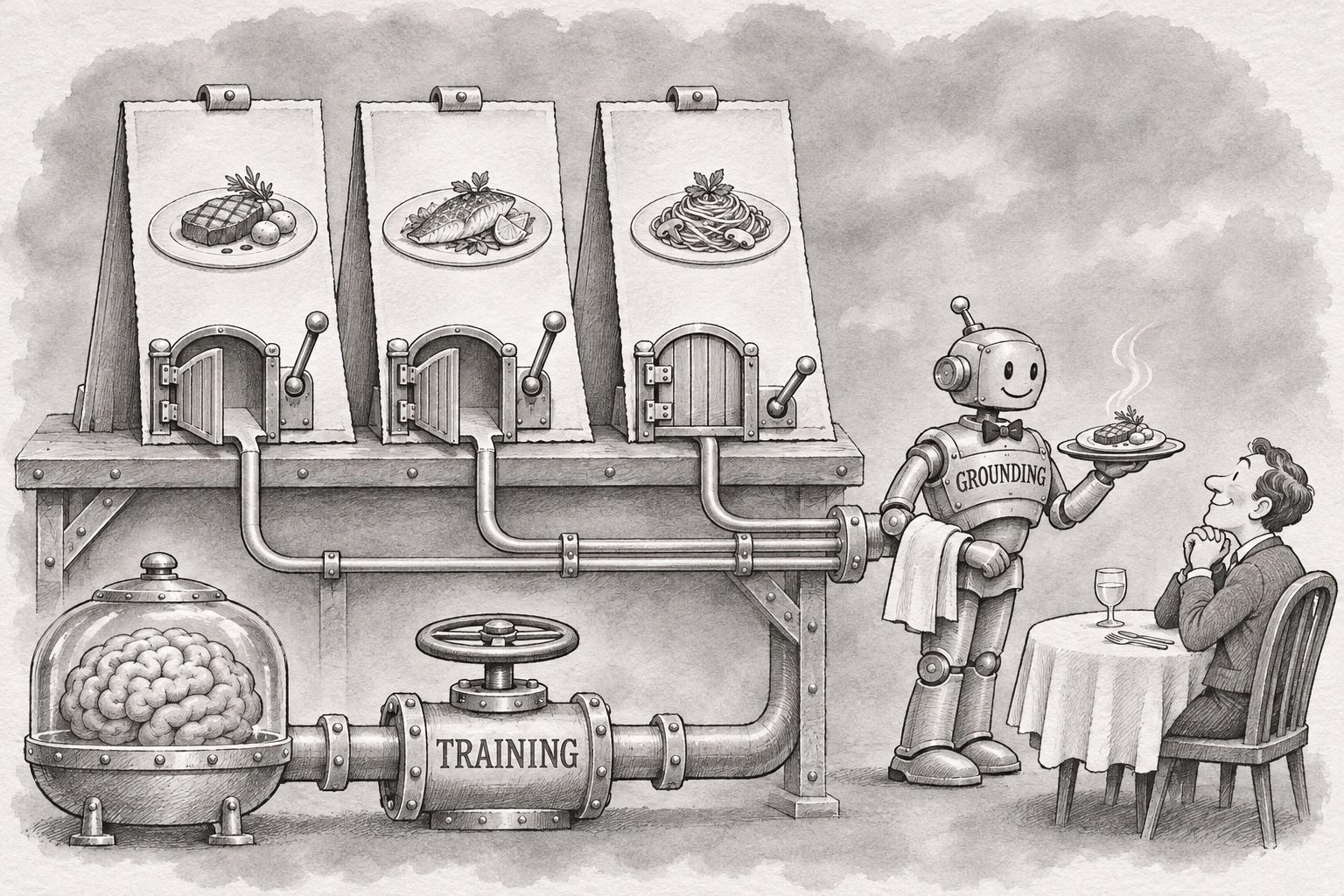
From 1 February 2027 a menu page can carry two separate instructions for Microsoft's crawlers: one refusing to let the content train generative models, another refusing to let it inform a generated answer. Until this week those were a single tag. Microsoft published the replacement on 30 October, and Google published its own commitment to the shared training signal underneath it the same day.
Grounding is the half with something at stake
Krishna Madhavan, a principal product manager on Bing, defines the two uses separately in Microsoft's announcement. AI Training "covers using an asset to modify the learned parameters of a generative AI model". AI Grounding "covers using content as input to help inform AI-generated responses", and the post rules out the likeliest confusion straight away: "Indexing and ranking pages in traditional search results is not grounding."
Training affects what a future model has absorbed. Grounding affects what an answer generated today is allowed to draw on, which is the route a diner actually arrives by. Microsoft is direct about the cost of refusing it — "If you select DisallowExtended or Disallow for grounding, you will see reduced brand visibility in AI experiences" — while both settings leave Bing's ordinary results alone, "subject to normal crawl and indexing requirements".
There is no site-wide grounding setting
The training preference has two homes. It can sit in robots.txt for a whole site or a path, under the shared token User-Agent: __usage_ai-training, or on a single page as <meta name="Bingbot" content="ai-training:disallow">, which overrides the file.
Grounding has one home, and Microsoft calls it "a separate page-level preference": "There is no site-wide robots.txt grounding preference." The tag is ai-grounding:disallow, or ai-grounding:disallowextended to keep content inside Microsoft's own products — AI Mode, AI Overview, Copilot and Microsoft 365 — and out of the grounding services it supplies to third parties through Web IQ and the Foundry API.
A menu on one URL is a single tag. A site that generates a page per dish or per location has a decision to render into every template that outputs one.
The old tags stop counting on 1 March 2027
Microsoft's 2023 controls were NoArchive and NoCache, and plenty of pages carry them for reasons that have nothing to do with generative models. Those tags are being retired as preference signals. Microsoft begins honouring the new ones on 1 February 2027 as it crawls, and after 1 March 2027 "NoArchive and NoCache will no longer be read as a preference for training or grounding".
Both new preferences default to Allow. A page whose only instruction is a NoArchive tag it inherited years ago therefore moves from withheld to eligible unless someone publishes the new preference and records a temporary one in Bing Webmaster Tools, a window that opens on 15 December 2026 and lapses on 30 September 2027. Publishing the tag is not the same as having it honoured, either: Microsoft notes it must crawl the page to discover the setting.
Google took the training opt-out industry-wide and left grounding alone
John Mueller's post on Search Central covers training and nothing else. Google will read the same policy token and treat it as a proxy for its own control: when a site uses the token to opt out "and Google-Extended is not explicitly specified", Google "plans to interpret that as if the publisher had disallowed Google-Extended". Support is aimed at 2027, and Google ties the approach to the EU Code of Practice for General Purpose AI Model Providers, which recognises robots.txt as a primary method for publishers to express machine-readable preferences.
The token comes from an Internet-Draft, draft-kelley-aipref-training-preference-signal, filed by Kevin Kelley of Anthropic and last revised on 30 October. Its datatracker page carries the standard disclaimer that the work is not endorsed by the IETF, and Nate Hake, quoted by Barry Schwartz at Search Engine Roundtable, said "some significant areas of dispute remain".
One line in robots.txt will soon express a training preference to several vendors at once. Nothing expresses a grounding preference to more than one. A restaurant that wants its menu quoted in answers but kept out of model training has to say the first thing once, and the second thing in the head of every page it minds about.