A smoked cod listing on Just Eat showed the fillet buried under a drift of loose flour. The words "wheat flour" sat beneath the dish name as part of the allergen line, and the image generator read them as an ingredient to render. Andrew Walsh collected that example and several others for The Journal on 20 October; Restaurant Online carried Just Eat's apology the following morning. "We're sorry for any inaccurate images that have been posted," a spokesperson said. "We've paused rolling this out while we further develop the tool to ensure it best serves our partners and customers."
The generator worked from the words and nothing else
The trial had a reasonable purpose behind it. Just Eat was producing photographs for smaller independent restaurants whose listings had none, sparing them the cost of a professional shoot, and an item with a picture sells better than an item without one.
What the generator had to work from was the text of the listing: the name of the dish, and whatever sat underneath it. No ingredient list, no category, nothing recording what kind of food the words described. Where the text was unambiguous it coped. Where it wasn't, it guessed, and the guess went live labelled "AI generated".
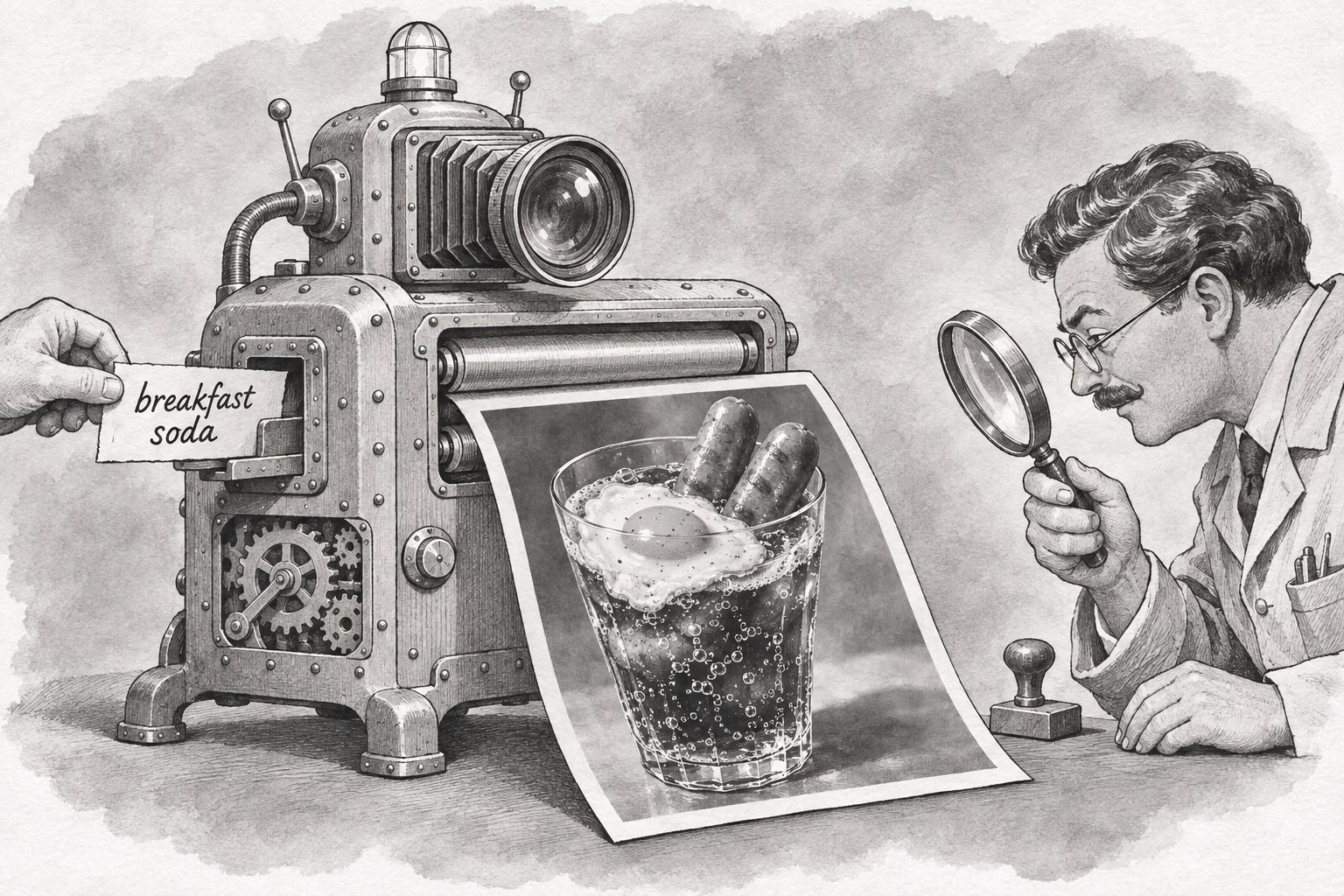
The failures read as a catalogue of those guesses. A "breakfast soda" came out as fried eggs and sausages floating in a glass of cola. Scampi was rendered as sushi. A batter burger arrived as a patty between two battered buns. A doner kebab was deconstructed across a plate with no kebab anywhere in it. Chips poked out of muffins, cheese was rolled into sushi, and watermelon chunks turned up in wine glasses.
British menu language is full of words that mean two things
The errors cluster around a particular kind of word. "Soda" in Belfast is soda bread, and a café's bacon and egg soda became a fizzy drink. "Plain" garlic bread, posted by the Instagram account @uknewestfoods, came out shaped like an aeroplane. "Batter" is a coating in a chip shop and a liquid in a kitchen.
None of these are obscure. They are the ordinary vocabulary of British takeaway menus, ambiguous in exactly the way a generative system cannot settle from the string by itself. Someone reading "bacon and egg soda" on a Belfast menu knows which soda is meant, because they know the shop and the city and the rest of the board. A model reading those four words has the four words.
A person checked every image
Just Eat's account of the process included review. The company said that "every AI image is manually checked by a person", and the flour-covered cod passed that check.
Review of that kind catches one class of error and not the other. It stops an image that looks wrong. It does not stop an image that looks plausible and is wrong, because the reviewer is working from the same handful of words as the model, with no record of what the kitchen actually sends out. Checking cannot supply information the process never had.
Just Eat kept generation to itself
Two details in The Journal's report sit oddly together. Restaurants could opt out of the trial whenever they wanted and upload photographs of their own. They were not permitted to use AI-generated images they had made themselves, because Just Eat said it wanted pictures that were accurate and realistic, with the technology kept under control.
The platform therefore held the generative rights over its partners' dishes while running the trial that produced the flour. A restaurant's remedy was photography, the expense the trial had been built to remove.
Structured fields are what settle the ambiguity
A dish published as a string invites a guess. The same dish published as structured data — a name inside a section, a price, the ingredients listed, dietary flags attached, an allergen recorded as an allergen rather than as two words printed below the title — leaves much less for a generator to invent, and gives a reviewer something to check an image against.
Just Eat has paused one of these tools. The words on a menu are still the brief handed to whatever reads one and makes something from it: a search result, a spoken answer, a picture. They were written for people who already knew what the dish was.