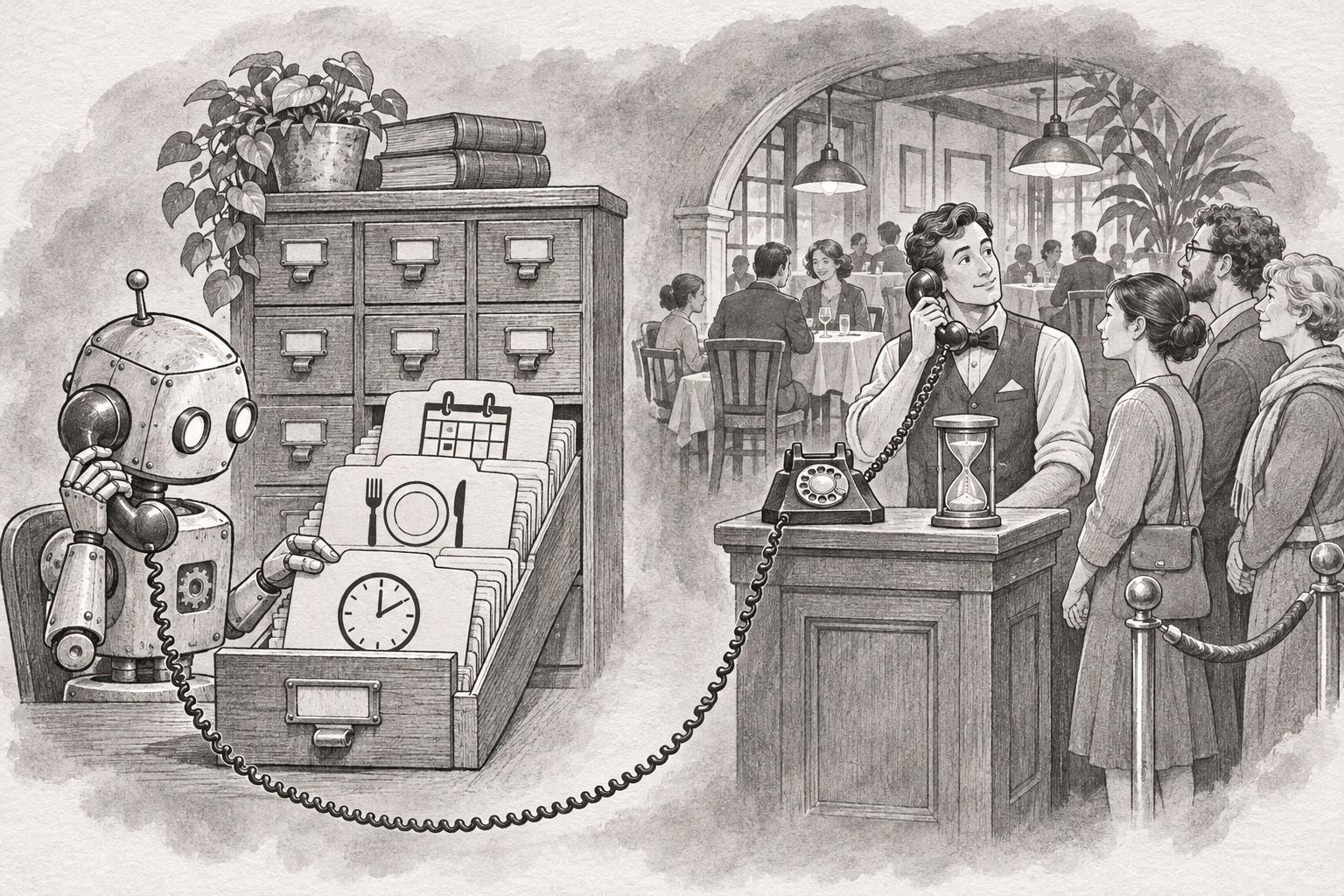
Yelp has built an AI agent that telephones a restaurant to ask how long the wait is. Check for Me landed on 20 October in Yelp's autumn product release, written up by chief product officer Akhil Kuduvalli Ramesh. A diner taps "Check wait time now" on an eligible restaurant's page, enters a party size and a phone number, and the agent rings the restaurant and texts the answer back within minutes. It covers walk-ins in the United States, on iOS, rolling out over the coming months.
No vocabulary carries a live wait
Schema.org's Restaurant type is generous about the things that hold still. It inherits openingHours from LocalBusiness, defines hasMenu and acceptsReservations on FoodEstablishment, and picks up maximumAttendeeCapacity from Place. That last one is as close as the vocabulary gets to a queue, and it is a total: the number of people the room holds, not the number standing in it now. Nothing in the type describes current wait, live occupancy or how busy a place is.
That absence is reasonable. A wait time stops being true faster than a crawler can fetch it, and a property that is wrong more often than right is worse than no property at all. But it leaves an agent that needs the number with one route to it, which is to ask a person. Yelp has automated the asking.
The restaurant answering may also be an agent
Ivan Mehta flagged the obvious failure mode at TechCrunch the same day: the diner's agent may end up talking to the restaurant's own voice agent, and that conversation might break down. He has the history to hand, noting that Yelp launched a voice agent for restaurants and service providers in 2025 — the business side of the same phone line. One Yelp agent calling another Yelp agent to establish a fact neither can look up is a fair description of where this ends up.
The rest of the release never picks up the phone
Every other restaurant feature in the same announcement resolves against stored data. Yelp Assistant can now book at tens of thousands of American OpenTable restaurants inside the chat, asking only for date, time and party size. It can join a Yelp Waitlist at eligible restaurants and notify the diner when a table is ready. Yelp puts the combined booking and ordering reach at more than half a million restaurants, across Yelp Reservations, Yelp Waitlist, OpenTable, DoorDash and Grubhub. The assistant also weighs the weather forecast, steering someone away from a patio-only spot when rain is coming.
None of that needs a call. Each of those facts is already written down where a machine can read it — a reservation record, a waitlist queue, a weather forecast. The wait time is the one exception in the release, and it is the one that got a phone agent built for it.
The published record sets the length of the call
Hours, menu sections, dish names, prices, dietary flags and whether the place takes bookings at all are facts that sit still long enough to be published as structured data. Published that way, they are answered before anyone dials. The call, when it comes, is about the single thing that genuinely cannot be written down in advance.
Leave them unpublished and the list of unanswerable questions gets longer. A menu that exists only as an image is not a menu an agent can quote from, so the agent falls back to whatever a third-party listing says the restaurant serves, or to not naming the restaurant. Neither outcome involves a phone call, which is the point: a voice agent will ring for a wait time, because Yelp built it to. Nothing is going to ring to find out what is on the menu.
The feature is American for now, but the design decision underneath it will travel sooner than the feature does. Agents are being built to read where there is something to read and to interrupt where there is not, and the cost of the second behaviour falls on whoever answers the phone. Every fact with a field waiting for it is a fact a restaurant can settle once, in public, and never be asked about again.