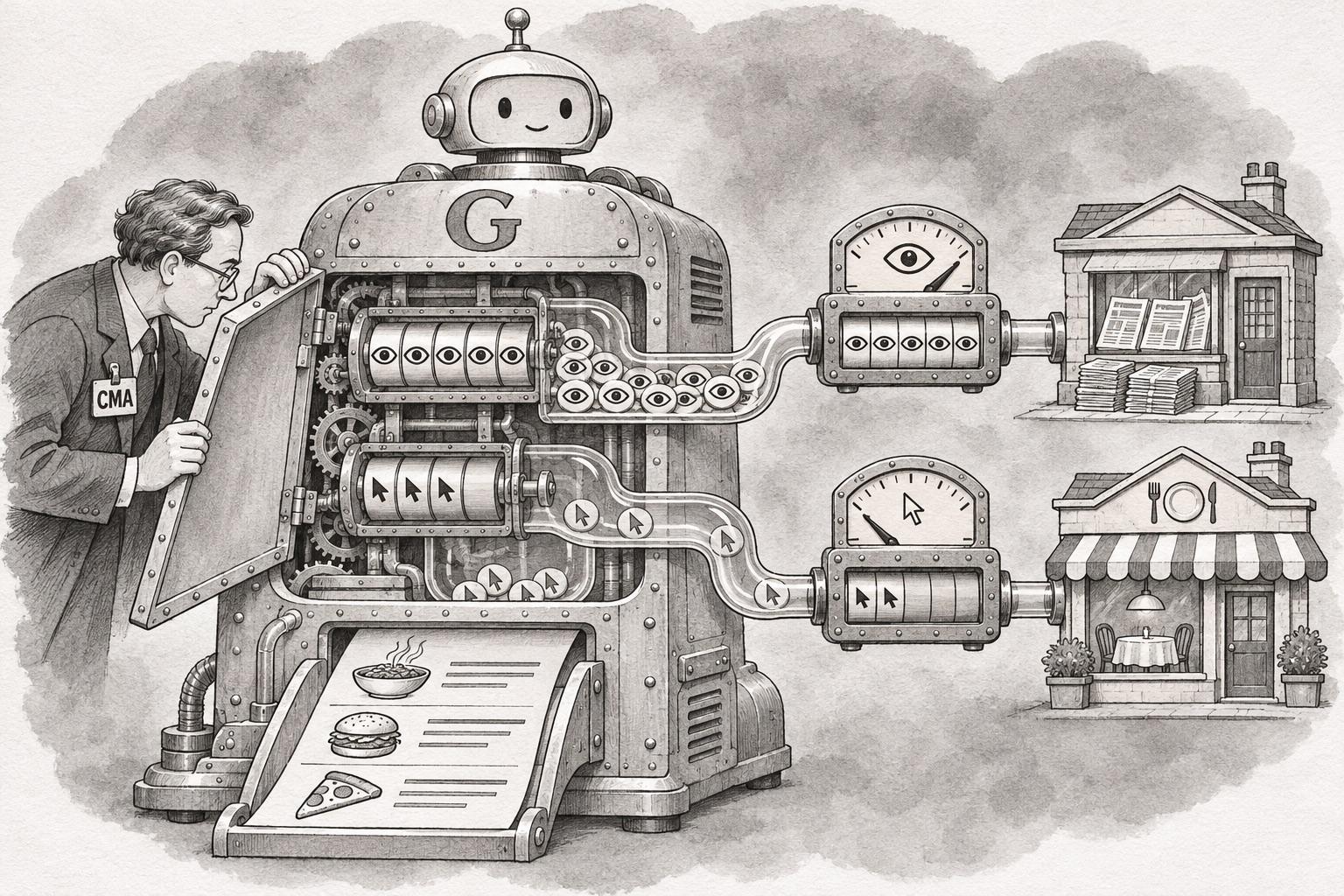
Google has until 3 December to tell UK publishers how many clicks its AI answers send them. The Competition and Markets Authority requires "clear and detailed metrics on user engagement" for AI search features by that date, and with a month to run, the Google staff who speak to site owners say there is nothing to announce.
The CMA named the metrics, not the principle
Matt G. Southern laid out the timetable at Search Engine Journal. The regulator's summary names impressions, clicks and click-through rate, aggregated across AI Overviews and AI Mode. Two conditions attached to that list do more work than the list itself: the data has to break down by individual publisher, and it has to separate an appearance inside an AI feature from an ordinary organic result. The CMA goes as far as naming where the numbers should sit, on a platform "such as Google Search Console".
December is one date in a sequence. Page-level controls fall due three months after it. The first compliance report covers 3 June to 3 December and is due on 3 January 2027.
Google's own staff are not promising the data
The public signals point the other way. Rajeev Lekhwar posted a quote on LinkedIn from an unnamed Googler speaking at a Search Central Live event: "The clicks and queries data is the most requested data set by website owners and SEOs," followed by the concession that "even we don't know by when this data will be added."
Gary Illyes answered on LinkedIn early on Monday. "I don't think we've phrased it like this," he wrote, then: "The team is super interested in giving more data, data that makes sense, but we don't have anything to announce yet." John Mueller added on Bluesky that there is "lots of helpful data which isn't currently in Search Console", and called the harsher reading of Illyes weird. Barry Schwartz wrote the exchange up at Search Engine Roundtable on 2 November as an implication that clicks and queries are not arriving soon.
Read closely, neither man said the data was being withheld. Neither said it was coming either.
The requirement names Search Console, not a publishing tool
The conduct requirement was drafted with news publishers in mind. The product it names was not built for them. Search Console is where any site with a verified property reads its own search data, and if Google satisfies the CMA by adding fields to a report that already exists, a restaurant reads them for the same reason a newspaper does. The report does not ask what kind of site it is.
The exposure is not the same, though. A publisher that loses a click loses the page view it sells advertising against. A restaurant that loses a click may still get the booking, because the answer carried the thing the diner actually wanted — the dish, the price, whether the kitchen does a gluten-free version — and the visit happens without the site ever loading.
Impressions count the appearance and clicks would count the cost
The Generative AI performance report has counted impressions since it reached all sites globally on 31 August. It shows no clicks, no click-through rate, no average position and no queries. Clicks from AI Overviews and AI Mode do land in the standard Performance report, but there is no AI-specific Search Appearance type to filter them out, so they sit inside the same total as every other result.
Adding clicks changes what an impression means. At present a restaurant can see that its menu page turned up in AI answers and can only guess what followed. With a rate beside it, two readings come apart. A page that is summarised and then visited is doing one job. A page that is summarised instead of visited is doing another, supplying facts to an interface the restaurant does not control, and knowing which of the two a menu page is doing separates editing it for diners from maintaining it for machines.
A metric a regulator can compel is a metric that exists somewhere already. If clicks arrive beside impressions in December, whether an AI answer replaced a visit stops being a matter of inference and becomes a column in a report.