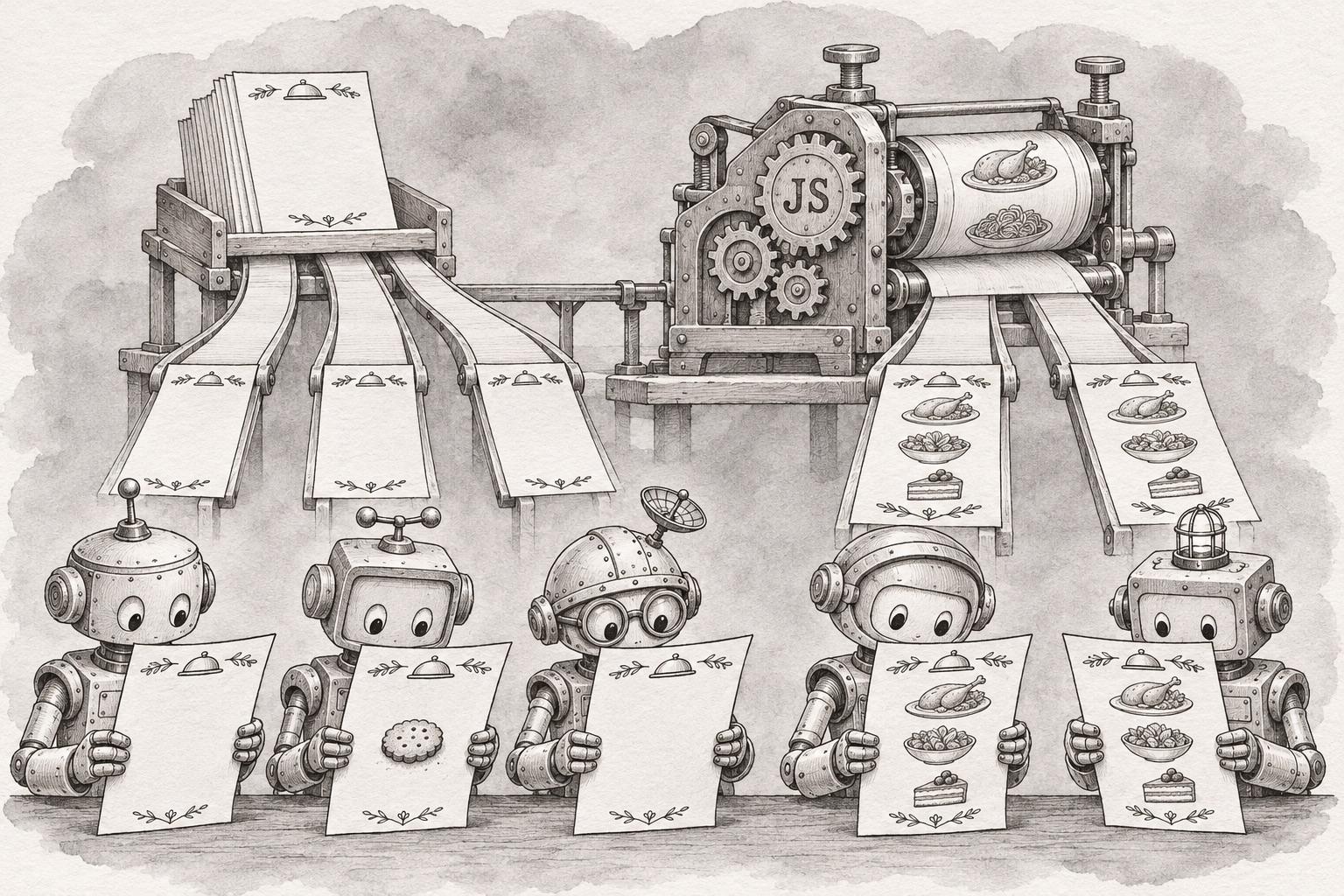
Four hundred and thirty-four days after his first attempt, Glenn Gabe asked five AI platforms to read pages whose text only appears once JavaScript has run. ChatGPT, Claude and Perplexity came back with the navigation, the footer and the cookie banner. Gemini and Copilot read the pages properly. He published the retest on 19 October.
The method is simple enough to copy. Gabe handed each platform a URL and asked it to return the first and last paragraphs. Three variants were tested: one with the main content rendered entirely by JavaScript, one with a static header and footer wrapped around JavaScript-rendered content, and one parallax WebGL site. ChatGPT failed the first two. Claude and Perplexity failed all three.
How the failures look from the inside matters more than the tally. On the fully rendered page, ChatGPT's extraction "returned only navigation and footer elements, not the main body text". Claude got "just the site chrome". Perplexity's attempt was "dominated by the cookie-consent content". None of the three reported an error. Each answered, out of whatever parts of the page happened to be sitting in the HTML.
The split follows the search index
Gemini and Copilot passing is not a verdict on model quality. Both sit downstream of a crawler that has rendered JavaScript for years. Gabe quotes Google's own guidance, that "Google is able to process content within JavaScript as long as it isn't blocked", and his earlier write-up says the same of Bing, which leaves Copilot inheriting the capability rather than building it. Gemini cleared all three tests, the WebGL one included, answering "Yes, I can read the page" on the first.
A second test drew the line further back
Andre Alpar reached a harsher conclusion in June, running twelve assistants against a single production site. A decoy reference number sat in the raw HTML; external JavaScript replaced it with the real one. Alpar read his server logs instead of trusting the replies, and by that measure "the entire US top tier reads raw HTML only" — Gemini and Copilot among them, with Copilot fetching the script through Diffbot and never running it. DeepSeek, ERNIE, Qwen, Kimi and Mistral returned the real number.
The two results are not strictly in conflict. Alpar's test required a second network call after the script executed; Gabe's only required the rendered text to arrive. A platform can clear the lower bar and miss the higher one. Alpar's warning survives either reading: "trust the server log, never the chatbot's description of itself." His Perplexity run claimed it could not access the page, while his logs showed its crawler had been served an HTTP 200.
Menu markup travels the same pipe as the prose
Neither test touched structured data, and nothing in them is a finding about JSON-LD. The inference is still difficult to avoid. Where a dish list is assembled in the browser, the JSON-LD describing it usually is too, injected by the same framework or written by a tag manager that fires once the document has loaded. A platform handed the HTML before any of that ran holds no menu and no markup, and has no way of knowing it.
The common path there involves no decision about AI at all. A restaurant moves to a newer site build, the menu becomes a component that fetches its items from an API, and the page looks right to whoever opens it. Nothing in the result shows which readers received the dish names and which received the nav bar.
The fix sits in the first response
Gabe's advice stays conservative: "I would still be very careful with how you leverage JavaScript-based content on your site." For a menu the firmer version applies, because the content is the product. Dish names, sections, prices and dietary flags belong in the HTML that returns from the first request, not in a second one. Menu software that renders the page and its Schema.org block on the server, GMMO included, removes the failure mode rather than monitoring for it.
The menus that survive this are not the ones on the newest sites. They are the ones whose dish names exist in the document before any script runs — a property most restaurants hold by luck, settled by whoever chose their platform, years before the question was worth asking.