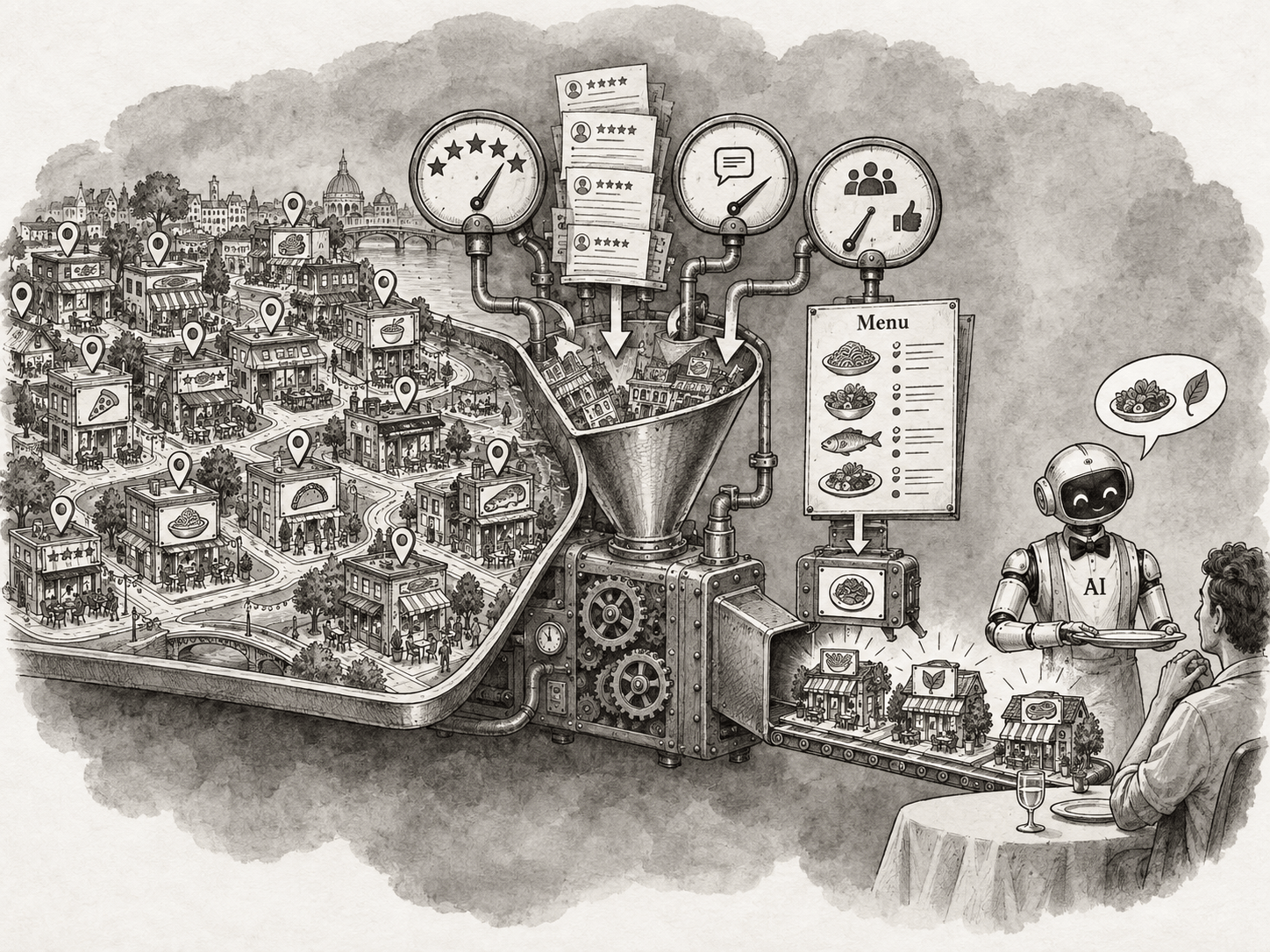
ChatGPT recommends expanding restaurant chains in about 20% of tested queries and contracting ones in about 3%, according to a benchmark SOCi published on Search Engine Land on 8 September. The piece is bylined to SOCi and carries the disclosure that "opinions expressed in this article are those of the sponsor".
The assistant slot is much narrower than the local pack
The most useful figure is not the growth gap. It sits in SOCi's wider Local Visibility Index, measured across brand locations generally rather than restaurants alone: "Only about 1–11% of brand locations are recommended across ChatGPT, Gemini, and Perplexity, compared with 35.9% that appear in Google's traditional 3-Pack."
That is a statement about capacity. Google's local pack has three positions and fills them for every search. An assistant asked where to eat replies in prose and names two or three places, so the number of businesses it can mention across a city is a fraction of what the pack shows. Ranking locally does not carry over into being named by an assistant, because there are far fewer names to give away.
The restaurant figures show the same compression. Expanding chains appear in the 3-Pack for 35.3% of tracked searches against 14.4% for contracting ones, a gap of roughly two and a half to one. On ChatGPT the same split is six or seven to one. The narrower the surface, the harder it sorts.
The index measures reputation, not food
The metrics are all about the listing and the audience around it. Google ratings of 4.39 against 3.82. Yelp ratings of 3.65 against 2.49. Review response rates of 72.4% against 43.6%. Local social engagement of 3.45% against 0.13%, with about five times the followers.
None of them measures what the restaurant serves. No dish names, no prices, no dietary tags, no allergen data. A benchmark of AI restaurant visibility that never looks at a menu is measuring how well a brand is regarded, which is a different question from how well it can be described.
That is less SOCi's failing than a reflection of what there is to measure. Ratings and review counts are public and comparable across sixteen chains. Menu data mostly is not, because most restaurants have never published it in a form anything could compare.
The direction of the arrow is unresolved
SOCi's framing is that expanding brands "treat local search, reputation, social, and AI visibility as one connected system", and that growing chains scored 61.4 on its Local Visibility Index against 46.6 for shrinking ones. The implication is that the digital work drives the growth.
The reverse reading survives the same data. A chain opening sites accumulates reviews, mentions, press coverage and social followers as a by-product of opening them, and assistants read the corpus that results. Nothing in the published article separates the two. There is no sample period, no query count and no list of the brands tested, so a reader cannot check.
A study of sixteen chains says little to one restaurant
Almost none of it transfers.
An independent cannot open new sites to lift its review volume, and most of what moved SOCi's index is scale of exactly that kind. Review response times and consistent hours are within reach of a single restaurant, but they were never the hard part.
What does transfer is the compression. If assistants name two restaurants where local search named ten, the deciding factor stops being presence and becomes specificity: whether a model asked about a gluten-free lunch can match that question to something concrete on your page rather than guessing from a rating. SOCi's own line is that "getting recommended at all requires clearing a much higher bar of data accuracy, consistent reputation, and differentiated content". For a restaurant the differentiated content is the menu, and it only counts as content if a machine can read it.