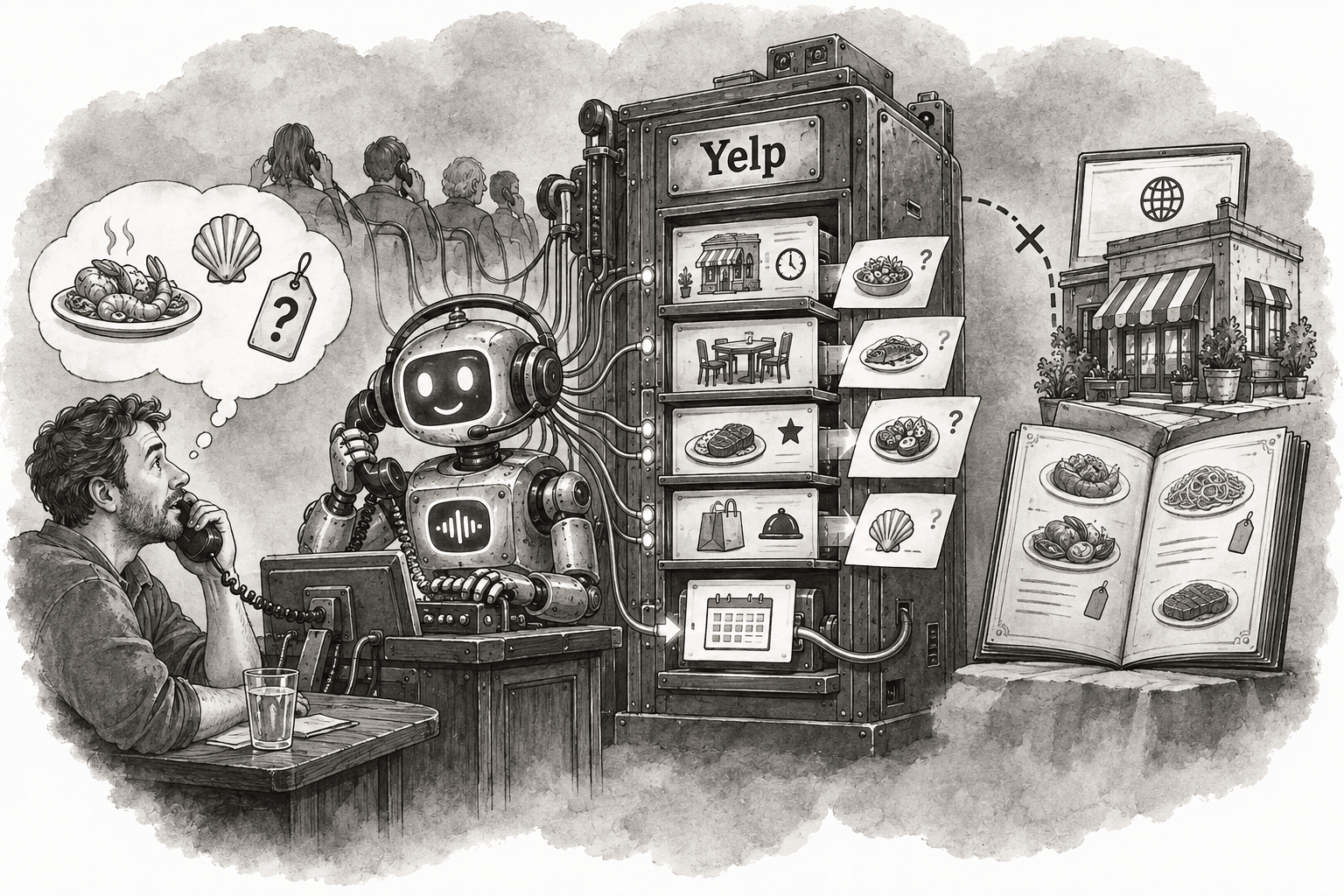
Yelp Host has answered more than a million restaurant phone calls since it launched in October 2025, and the voice model underneath it has just changed. Yelp and Hatch are among the first deployments of GPT-Live-1, OpenAI's new full-duplex model, which can listen and speak at the same time. PPC Land reported the switch on 10 September.
The voice is the demonstration. The part a restaurant should read twice is the sentence about where the answers come from.
The grounding is Yelp data, not the restaurant site
Yelp's announcement says the agent draws on "business information on Yelp, reservation availability, food ordering, menu specials, seating areas". Akhil Kuduvalli Ramesh, chief product officer at Yelp, framed the advantage as data rather than delivery: "Powered by our reliable business data and frontier tech stack, Yelp Host's value to restaurants is not only how it sounds, but how deeply it understands each restaurant's operations."
Every item on that list is a record Yelp maintains. The restaurant's own domain does not appear on it. A caller who rings to ask about the food is put through to a model reading a platform's copy of the place, and the accuracy of the answer is a function of how current that copy is.
Specials are named; dish detail is not
The grounding list reaches menu specials. It stops well short of the thing callers actually ring about: what a dish contains, what it costs today, whether the kitchen can work round an allergy. Someone asking whether a dish contains shellfish is asking a question the list does not promise to cover, and a voice agent with no entry for it either declines or reaches for something adjacent.
That gap existed before this week. What has changed is the volume arriving at it. Yelp Host grew 38% month on month between October 2025 and June 2026, and by July was running at an annualised 2.4 million calls, with entry pricing at $249 a month. A thin record answered a handful of calls a week at launch; it now answers them at the rate of a contact centre.
Full duplex raises what callers attempt
The older generation of voice agents worked because callers adapted to them. People learned to speak in short phrases and wait for the beep. GPT-Live-1 removes the reason to do that. Yelp describes conversations that accommodate natural pauses, interruptions and overlapping speech, with the model detecting a caller's tone — Yelp's own examples are "excitement, frustration or impatience" — and adjusting to it. It also detects and answers in nearly any language automatically.
A caller who can interrupt asks a harder question than one navigating a keypad. Conversational latitude pulls queries towards specifics, because specifics are what people actually want to know and the interface no longer punishes them for asking.
Two copies of the restaurant now answer questions
Yelp Host added OpenTable in July 2026 so it can check reservation availability against a live calendar. Where the agent needs a fact that moves, Yelp wires it to the system of record rather than keeping a copy that goes stale.
Menu content has no equivalent connection here. It sits in whatever form the restaurant has published it, in as many copies as there are platforms holding one. The version on the restaurant's own pages is what crawlers and assistants read. The version inside Yelp is what the phone agent reads. Nothing reconciles the two, and when they disagree the caller hears Yelp.
Teri Yu, multimodal product lead at OpenAI, described the deployment as using the new capabilities "to solve everyday problems for local businesses". The everyday problem being solved is the unanswered phone, which is real, and worth solving. It is being solved by pointing a fluent model at whatever data is already lying around about the business.
The script for a million-call phone agent is already written. A restaurant that has never read what Yelp holds about its food does not know what is in it.