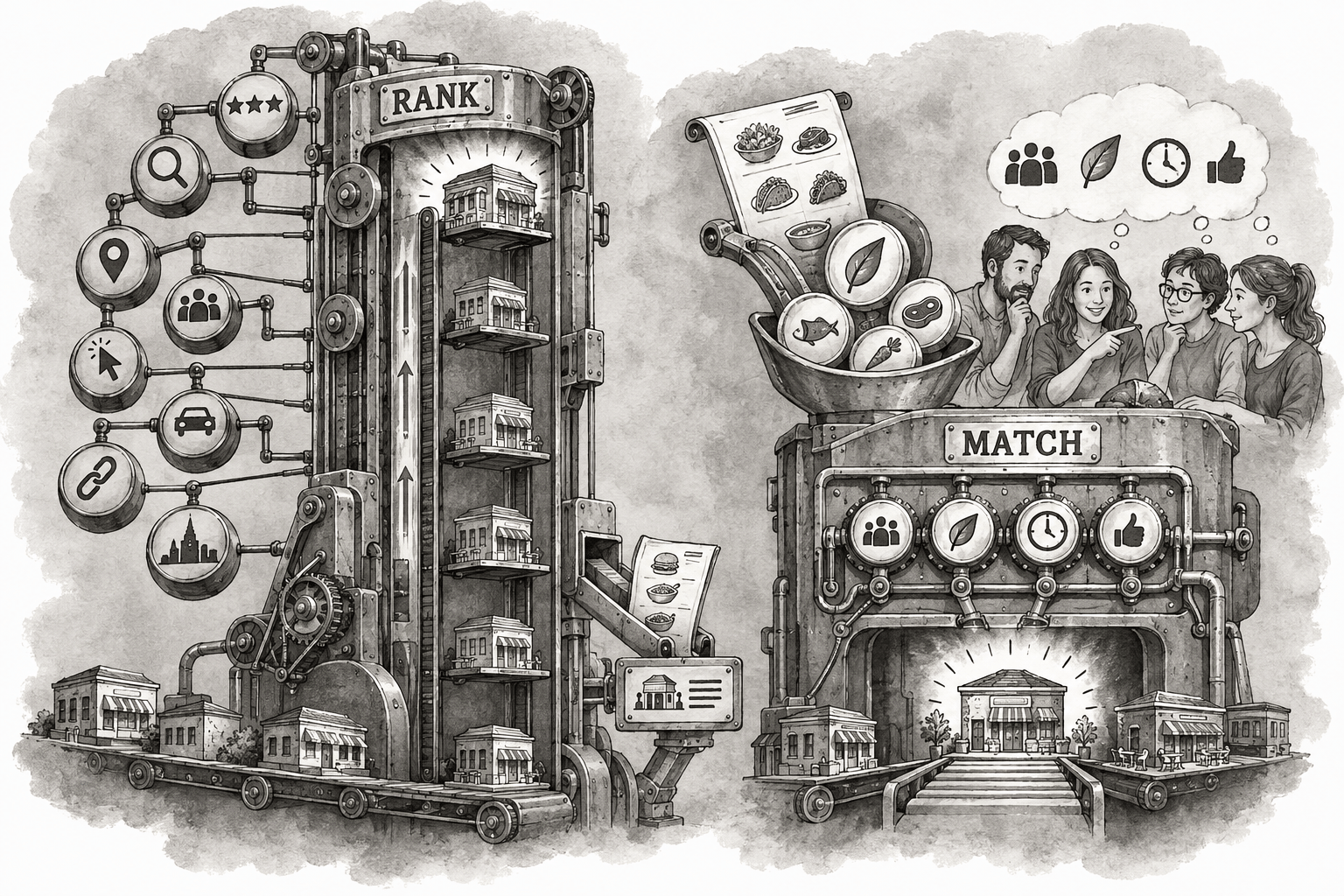
Search Engine Land published an inventory of Google's local ranking machinery on 8 September, assembled from a binary that exposes a non-public scope of Geostore, the internal store holding every business Google knows about. Olivier de Segonzac, co-founder of the French consultancy RESONEO, names the ranking component Oyster Rank and puts its signal count at 72.
Twelve of those names appear in the piece. Not one is anything a restaurant writes.
The published signals measure attention rather than content
The list runs: "Google reviews. Web query volume. Listing impressions. Listing opens. Direction requests. Website clicks. Chain membership. Wikipedia signals. Popularity. Prominence. Landmark information. Road usage."
Six of the twelve are counts of what other people did — reviewed, searched, tapped, asked for directions. Chain membership and Wikipedia signals ask how large and how documented the business already is. Landmark information and road usage describe the street outside. Rewriting a menu page tomorrow moves none of them directly.
That is a useful thing to know before buying anything sold on the promise of a better Maps position. The signals that decide who appears in a local pack are mostly downstream of trading well and being talked about.
Geostore describes a business, not a page
Everything in Geostore is a Feature, and de Segonzac's summary of the type is broad: "A Feature can be a business, building, road, city, station, area, transit element, or even a 3D object." A restaurant's Feature holds identity, geometry, its website, relationships to other businesses, Knowledge Graph references and ranking data in a single record.
That record is assembled rather than authored. The article puts the number of contributing sources at 793 providers, reconciled by a process it calls conflation, which chooses, merges or combines conflicting values according to trust levels running from blocked up to super-trusted. A restaurant's own site is one input among those. The test the article poses for it is not whether the page ranks but something plainer: "Does its website describe the same entity clearly?"
Dishes exist as entities in the semantic layer
Beneath the listing runs a semantic layer the article calls GConcepts, and one sentence in that section should interest anyone building menu software: "Review topics, menu dishes, and other attributes can be represented as entities rather than plain strings." A dish, on that account, is not a phrase Google re-reads on every query. It is an object that can be counted, compared between restaurants and matched against a constraint. The webref layer connects documents to those entities and stores topicality, confidence, geographic metadata and document-level scores alongside them. Ranking and matching are doing separate jobs here, and only one of them is a popularity contest.
Ask Maps asks for things the ranking signals cannot measure
The contrast de Segonzac draws is between "Best ramen near me", which he calls "relatively easy", and the sort of question Gemini now accepts inside Maps: "Where can six people eat near my hotel tonight, with one vegetarian, little waiting time, and good recent feedback about service?" Direction requests cannot resolve the vegetarian clause. Neither can prominence, listing opens or any other tally of past attention. Whatever answers it has to come from attributes attached to the place, and the article names the dish as one of the attribute types the system already models.
The recovered material has limits
Twenty-five of the 72 values are marked deprecated in the binary itself. The author is explicit that "we recovered the signal names, not their current weights", which leaves the ordering unknown: a signal can be present and count for almost nothing. The material is obtained rather than documented, Google has not commented on it, and RESONEO cross-referenced it against network traffic, on-device components and the 2024 Google leak rather than against anything Google published.
Sixty of the names are still unpublished. Nobody outside that team can say what sits further down the list, and it would be a mistake to read twelve examples as the whole ranking model.
What the inventory does settle is narrower and more interesting than a ranking tip. Google's local stack already models the dish as an object rather than as text, and the conversational layer above it has started asking dish-shaped questions. That gap gets filled by attribute data or it gets filled by inference.