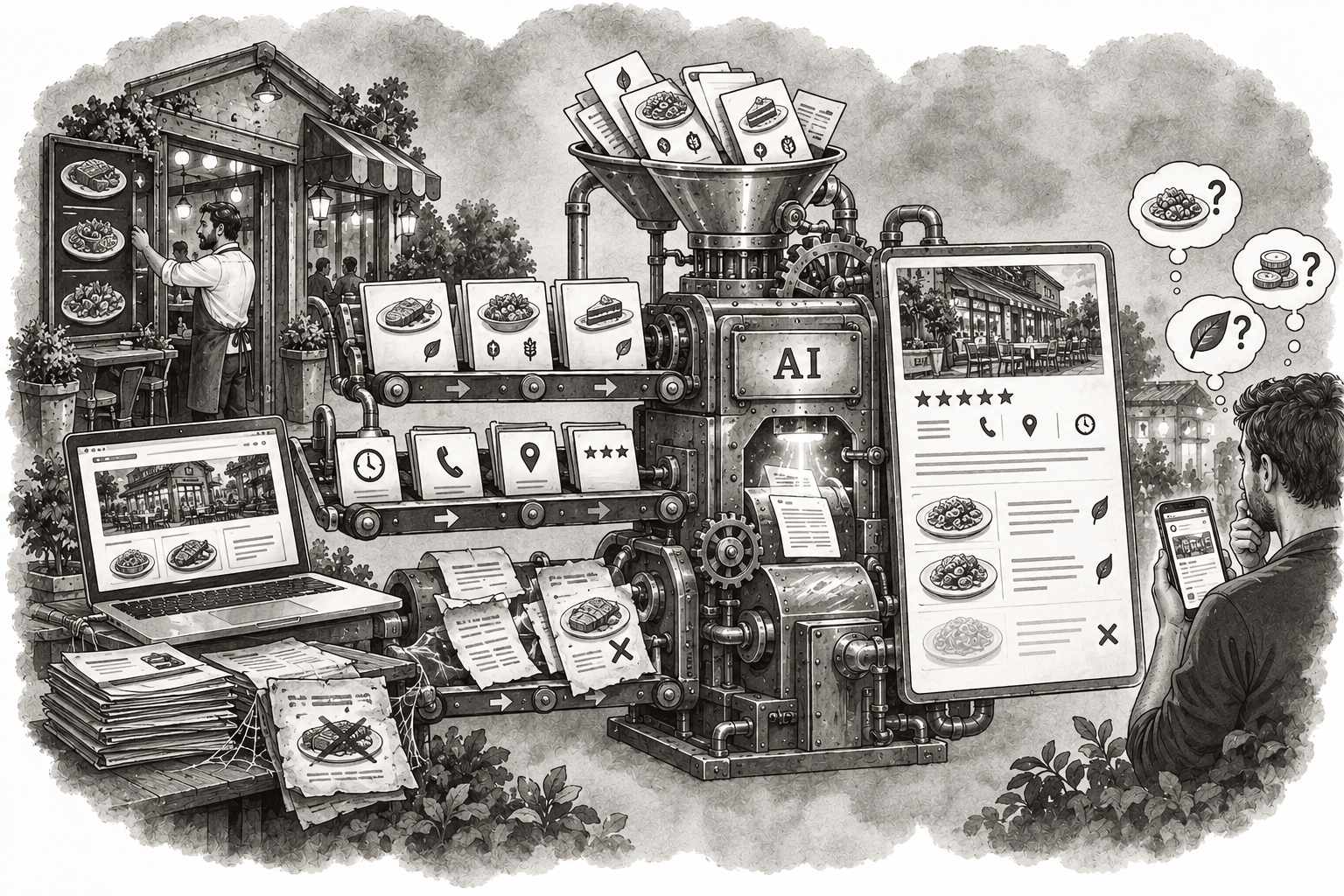
Google Search has started putting an "AI Overview" label at the top of the local knowledge panel, the Business Profile card that carries a restaurant's hours, address and phone number. Beneath the label sits a generated description of the business, and a "Show more" button expands it into the AI Mode chat interface. Ben Fisher posted the find on LinkedIn; Barry Schwartz replicated it and published his own screenshots on 17 September.
His verdict was mixed in a specific way. "While most of it is correct, the niche solutions is a tad old but I can't blame the AI because the content on my corporate site is super old as well." The generated text was accurate where his website was accurate, and stale where his website was stale.
A generated description inherits the page it was generated from
That is one person checking one listing, and Google has published nothing about where the panel's text is drawn from. It is also the most useful observation anyone has made about the feature so far: someone who writes about search for a living read a machine-written description of his own business, recognised which parts had gone off, and traced them to pages he had not touched in years.
The failure mode is not the one restaurant operators have learned to manage. A Business Profile goes wrong when nobody updates it in the Business Profile dashboard, and the repair is a few minutes in a form. A generated summary goes wrong when the website is wrong, and the website is the asset that sits outside the daily routine, updated on a different schedule by whoever built it rather than by anyone in the kitchen. Hours and holiday closures get maintained because the dashboard asks for them. The menu page is where the drift collects, and until now that drift cost nothing at the top of a restaurant's own branded search result.
The panel expands into questions its own fields cannot hold
A knowledge panel is a fixed set of slots: name, category, hours, phone number, a star rating, a photograph or two. None of that structure has anywhere to put the price of a main course, which dishes are running this week, or whether the kitchen can turn something out without gluten. Those are the questions diners actually arrive with, and the Show more button is what lets them ask.
Because the expanded view is AI Mode, the reply comes back as prose assembled from whatever the model can read. Dish-level facts have to exist somewhere machine-readable before that can happen, and for an independent restaurant the realistic candidate is Menu, MenuSection and MenuItem markup on its own domain. Where that markup is absent, the model works from body copy, a PDF, or nothing.
The exposure runs in the other direction as well, because markup that is machine-readable and wrong gets read with confidence. A dish comes off the board and the JSON-LD does not follow; the panel goes on offering it to people who then order it.
Schwartz objects to the authorship, and no setting addresses that
"I am not sure I want AI describing my business, when I can," he wrote. Google is not offering a switch that puts the fields back, and by his account it has been "testing variations of this for a while now" — which makes this particular layout provisional and the direction of travel reasonably clear. No country list came with it and no announcement, so a UK restaurant cannot assume its own panel looks like this today.
What is adjustable is the input. Menu software that emits Schema.org as a by-product of editing the menu, GMMO among them, closes the gap between the price on the board and the price a model can quote.
The label at the top of the panel is the change people will notice. The consequence sits behind it: the most prominent description of a restaurant in Google Search is now a paraphrase, and a paraphrase has a source. Anything a restaurant published once and stopped thinking about is eligible to be read back to a diner who never opens the site at all.